Calisthenics: An effective, low-frills way to stay fit
The word calisthenics may not come up often in fitness conversations these days, but this classic form of body-weight exercise never goes out of date. It can deliver an excellent, well-rounded workout with no equipment at all. Here is a look at its many benefits and a sample routine to get you moving.
What is calisthenics?
Calisthenics is strength training that uses your own body weight as resistance for full-body movements. Fitness professionals consider it an effective way to stay in shape, one that can improve strength, endurance, flexibility, and coordination together.
Push-ups, sit-ups, and jumping jacks are calisthenics moves you may remember from school gym classes. Popular additions such as squats, chin-ups, burpees, and planks have since joined the mix. The exercises range from easy to demanding, and each can be modified to suit your fitness level.
Why calisthenics is worth doing
People have practiced calisthenics since ancient Greece, and it brings multiple benefits. Here are a few:
Convenience: calisthenics became one of the most popular forms of exercise during the COVID-19 pandemic. The moves can be done anywhere, at any time, whenever and wherever suits you, with no special equipment. And it costs nothing.
Adaptability: body-weight exercises can be shaped to any fitness level, whether you are just beginning or already an athlete. As you grow stronger, you can complete more repetitions or add challenges such as pulses or isometric holds.
Efficiency: even modest amounts of body-weight exercise pay off. In one study, a routine of eight simple lower-body moves, including squats, knee lifts, and heel raises, produced a 15% increase in muscle strength and power after 10 months.
Effectiveness: body-weight training delivers, which is why both the military and elite gymnasts rely on it. Research shows it can build muscle effectively without external weights, and studies also find calisthenics improves aerobic capacity, muscle endurance (especially in the core), and flexibility.
Getting started with calisthenics
Starting is simple because you need no equipment or gym membership. All you require is enough clear space to do the exercises safely, such as a flat stretch of floor at home.
A small repertoire of dependable go-to moves also makes a new program easier to begin. You can make those same exercises more challenging as your strength and stamina develop.
Before beginning any new exercise program, talk over your goals and plans with your doctor, especially if you have a condition such as heart disease, diabetes, arthritis, or osteoporosis.
To get the most from your calisthenics program, keep these tips in mind:
Warm up properly. Spend five to 10 minutes warming up before a workout. This prepares your body by sending more oxygen to your muscles, loosening your joints, and increasing your range of motion.
Build up gradually. Taking on too much too soon invites injury. As you gain strength, add repetitions, sets, and new exercises slowly.
Focus on form. As with any exercise, good technique brings the greatest benefit and helps you avoid injury.
Don't lock your joints. When straightening your legs and arms, always keep a slight bend in your knees and elbows.
Work within a pain-free range. Move your arms and legs only through a range that feels comfortable.
Let muscles recover. The American College of Sports Medicine recommends only two or three full strength workouts a week, with a day of rest in between.
Keep movements slow and controlled, and breathe throughout. Blood pressure rises when you hold your breath during resistance exercise.
A sample calisthenics workout
You can build a routine from the exercises below. For strength training, aim for eight to 12 repetitions, or reps. If you cannot manage them all at first, do what you can and add reps as you improve. Beginners can start with one set and work up to three sets as strength develops, resting 30 to 90 seconds between sets.
Knee lift (warm-up exercise)
Starting position: stand up straight with your feet together.
Movement: lift your right knee as high as is comfortable, touching it with both hands. Lower your leg, then repeat with the left knee. That is one rep.
Half squat
Starting position: stand with your feet shoulder-width apart and your arms at your sides.
Movement: slowly bend your hips and knees, lowering your buttocks about eight inches as if sitting back into a chair. Let your arms swing forward to help you balance, and keep your spine neutral. Hold, then slowly return to the starting position.
Kneeling push-up
Starting position: kneel on all fours with your hands shoulder-width apart. Walk your hands forward and lower your hips so your body sits at about a 45-degree angle to the floor and forms a straight line from head to knees.
Movement: bend your elbows out to the sides and slowly lower your upper body toward the floor until your elbows reach about 90 degrees. Press against the floor and straighten your arms to return to the start.
Make it harder: lift your knees off the floor and do push-ups balanced on your hands and the toes and balls of your feet.
Side lunge with a knee lift
Starting position: stand up straight with your feet together and your arms at your sides.
Movement: step out to the side with your left foot while your right foot stays planted. As your left foot lands, shift most of your weight onto your left leg, hinge forward at the hips, and bend your left knee to lower into a lunge. Keep your right leg straight and rest your hands on your left thigh for support. Press through your left foot to stand back up, shift your weight onto your right foot, and lift your left knee to hip level. Find your balance, then step out with your left leg into another lunge. Continue for 30 seconds, then repeat the sequence stepping out to the right for 30 seconds.
Plank with a knee drop
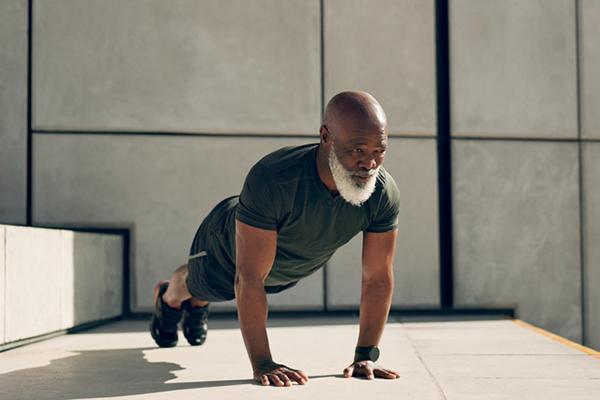
Starting position: kneel on all fours with your hands and knees directly under your shoulders and hips. Extend both legs behind you with feet flexed and toes on the floor, balancing on your palms and the toes and balls of your feet, like the top position of a push-up. This is the plank.
Movement: tighten your abdominal muscles. Lower both knees toward the floor, then straighten your legs to return to the plank.