Jensen Huang on AI architecture, investment and growth: Interview transcript
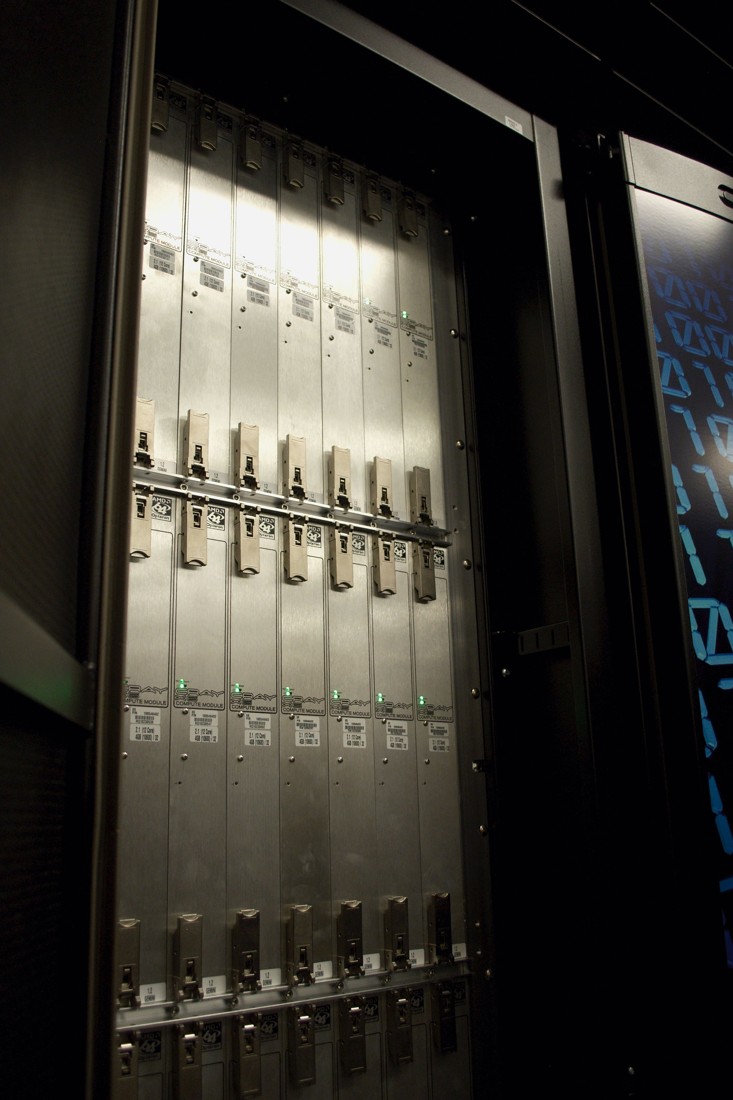
Illustrative photograph of compute modules in the Hopper Cray XE6 supercomputer, not an NVIDIA system or the interview venue.
And and we're the fastest computers. Um we're we're the only architecture that's general purpose. Meaning we run every closed model. We run every open model. We run biology models to language models, auto regressive models to transformer models to diffusion models and all the different various technologies. The challenge of generalization is of course performance. You know, how can you be the world's fastest F1 race car and also be a really great sedan? And so that's in the industry. I think the narrative of the industry is is really out of control and ought to be stopped. Um but that's that's just a industry growing up. You probably remember the good old days of the internet and um the industry grew up. And I think that our industry is is uh many of the young companies um are going through their growing pains and and they're growing of course incredibly fast. There's an accountability responsibility uh that goes along with building companies that I think they was they're just growing into.
Nvidia keeps adding new products, buying up companies. In some cases you're competing with your own customers. Why do you need to have such a broad range of offerings? Um we do as little as we can. I mean it's It seems like you're doing a lot. Uh surprisingly little. I think we've done a good job uh generalizing the the work that we do so that it could be applied to many different things. Not because we're doing many different things, it's because we generalized one thing. And so if you look at our architecture, we're the only architecture that's general purpose. Meaning we run every closed model. We run every open model. We run biology models to language models, auto regressive models to transformer models to diffusion models and all the different various technologies. The challenge of generalization is of course performance. You know, how can you be the world's fastest F1 race car and also be a really great sedan? And so that's in that's the miracle of the technology that we've created. On the one hand, we're the world's fastest F1 racing cars. And and we're the fastest computers. Um we're always at the top of the leaderboard. Uh you know, you benchmark us, we're always the best. On the other hand, because we're fungible, we're also the lowest cost.
Nvidia recently committed to spending about half a trillion dollars across the global AI industry and that number is quickly climbing. There's concern that in doing so, Nvidia is creating false demand, giving companies the money they need to turn around and buy products from Nvidia. It's no secret that critics have accused Nvidia of circular financing. How do you tow the line between boosting promising startups and blowing up a bubble? Like if AI is such a gold mine, why do you have to underwrite so much of it? Yeah. Yeah. Yeah, this technology requires high CAPEX. If you look at this generation of AI startups, um it's very very rare that you find a company that can be funded on $10 million. And it's not unusual to find a company that requires $10 billion. And the reason for that is because it needs this computation resource in order to uh deliver the intelligence. Some of the highest quality companies in the in the AI ecosystem across each one of the layers of the five layer cake, it connects us to the best and the most talented companies. It helps us continue to advance Nvidia's platform if you will because these companies are going to be built on Nvidia's technology. And it helps us capitalize and be one of the early investors in many of them. We have a a highly disciplined approach of making sure that we are, although one of the earliest investors and many times even the anchor investor, we're not the lead investor. We're not the largest investor. In all cases, we own less than 20% of the company. We've invested some, I guess in the last 5 years, maybe close to $100 billion or something like that. That $100 billion resulted in well at least five times as much other institutional investors into this ecosystem.
Most of the world's leading AI companies depend on Nvidia, not just your hardware but your software as well. We're probably the only AI company in the world that works with every AI company in the world. So at what point does that dependence on one single company become a systemic risk? Well, they don't depend on us, they choose us. I don't worry about that. And the reason for that is because uh we we don't take our position for granted. We came from nothing and uh we have to earn our keep every day. We have competitors in every company, every industry, every country. With respect to the size the size of the market, just remember it's just a number. Um Nvidia Nvidia can only be as large as the the if you will the pond that we're in, the market that we're in. When somebody asks me, America needs to win the AI race, what I hear is not that one or two or three companies wins the AI race. What I mean is America's companies win the AI race. If we do the opposite, we scare people and we cause people anxiety, then America will lose.
In a new administration, will Nvidia's dominance be at risk? Are you prepared? Are we prepared? Yeah yeah, sure. I'm in service of our of our policy makers and our leaders and whatever they want to talk to me about, um I'm more than happy to let share with them what I know. I know a lot about this technology. I know a lot about engineering and and I know what it takes to build this and I know what we're doing to build it. And if you ask me um my my thoughts on uh whether we can advance AI uh with prosperity for the future while doing so every single step of the way safely and responsibly, I have absolutely zero concern that we have the ability to do so. Now whether we would do so is a completely different thing but we have the technology to do so.
You said AI supply and demand will balance out in maybe five to 10 years. What happens when the world doesn't need as many new chips? Uh new chips will replace the old chips. Just uh kind of like the personal computer industry. You know, we got what a billion users in the world today. Um in 1993 when Nvidia was first founded, the personal computer industry was doubling every single year. And of course it doesn't double anymore. At the moment, we're kind of doubling every year. And my sense is that we're going to keep doing that as we build out the infrastructure of the world. And how far out can you see that doubling? Um you know, we're going to do that for several years. And and then and then we'll we'll reevaluate. And so we're kind of 2 years into an infrastructure build out. And and uh if you look at previous technology cycles, uh it takes about 10 years or so to to reach some kind of maturity. And then after that, you're in replacement cycles. And so did that with phones, did that with the internet, did that with PCs. Um I think it'll happen here too.
Could there be a breakthrough that means AI is powered by a fraction of the energy? Oh yeah. Oh yeah yeah yeah. And then what does that mean for Nvidia? No, we're just going to keep making things more efficient. Um there's a weird there's a weird dynamic. You know, people used to tell me, hey Jensen, if you make your chips that much better every generation, doesn't that say that customers would buy less? You know, and and that same exact logic goes, if we make companies more productive, don't we hire less people? And there's there's this weird thing called ambition. If you gave me 36 hours a day, I'm not going to sleep more, you know, because I'm you know, I've got ideas, I've got things to do. We'll end up doing more. And so if AI makes us all more intelligent, I become more ambitious. If the cost of doing something uh becomes marginally close to zero, uh it turns out that resource becomes widely abundant. I think the economy is going to get larger. I think the industries will get larger. I think the semiconductor industry will be at this point very clearly one of the largest industries in the world.