Four age-related eye problems that can cloud your vision

November 13 clinical clarification: pressure testing and eye vitamins
The earlier glaucoma paragraph needs an important qualification. Measuring eye pressure, called tonometry, is useful but is not enough on its own to diagnose or exclude glaucoma. Some people develop glaucoma with pressure in the usual range, while some people with raised pressure do not develop the disease. A comprehensive dilated eye examination includes assessment of the optic nerve and other tests such as visual-field testing when needed. A reassuring pressure reading is not a substitute for the examination your eye-care professional recommends.
The earlier statement that a vitamin formula can slow dry age-related macular degeneration also needs a stage-specific limit. AREDS/AREDS2 supplements are not a general prevention treatment and did not benefit people with no AMD or early AMD in the trials. They may reduce progression risk for certain people with intermediate AMD or late AMD in one eye. An eye-care professional should determine the stage and whether a particular formulation is appropriate. These high-dose products are not interchangeable with an ordinary multivitamin; beta-carotene-containing formulas can be unsuitable for current or former smokers because of lung-cancer risk. Do not start them merely because of age or an undiagnosed change in sight.
These clarifications follow current National Eye Institute information and take precedence over the broad wording in the dated article below. The source article's four topics remain cataract, glaucoma, age-related macular degeneration and diabetic retinopathy. Its explanations of the lens, optic nerve, macula and retina are retained in both languages, together with the importance of eye examinations and diabetes-related blood-sugar and blood-pressure management. This educational article does not diagnose a reader or choose a treatment.
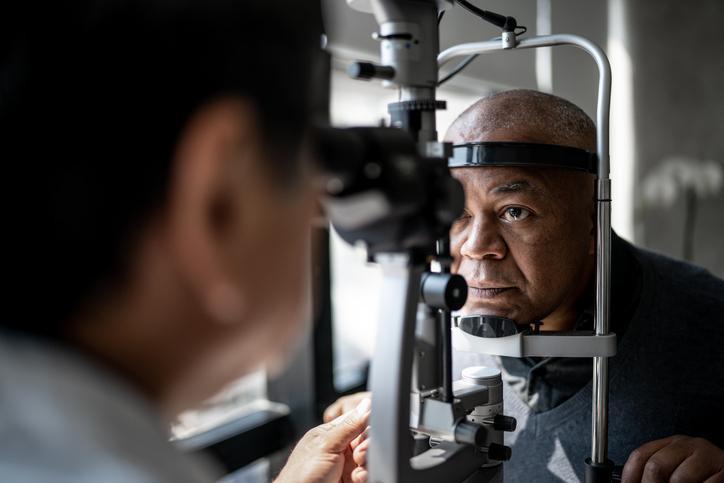
Your eyes change naturally over the years, just like the rest of your body. Regular eye exams matter for keeping your sight clear and your eyes healthy as you get older.
Four conditions become increasingly common with age:
Cataract. The lens slowly clouds over, usually across many years. You might not register the change until the clouding blocks your central vision. An eye doctor can spot it during a routine check, but when - or whether - surgery becomes necessary is hard to predict.
Glaucoma. This condition typically arises when fluid builds up and pressure rises in the front of the eye. It is often labelled a "silent" disease because most people notice nothing until the optic nerve is damaged and sight begins to fade. The surest early catch is tonometry, a quick eye-pressure test included in standard eye exams.
Age-related macular degeneration. AMD injures the macula, the region of the eye that resolves fine detail at the centre of your vision, which can make reading, writing, or driving difficult. It comes in a dry form and a more advanced wet form. A specific vitamin formula can slow dry AMD, and effective treatments now exist to slow the wet form too.
Diabetic retinopathy. Diabetes means excess sugar in the bloodstream, which can harm blood vessels and organs throughout the body, eyes included. Keeping blood sugar and blood pressure well controlled can postpone - and even prevent - diabetes-related eye damage.
When diabetic retinopathy does develop, the cause is fragile or leaky blood vessels in the eye that injure the retina, the light-sensing layer at the back of the eye.